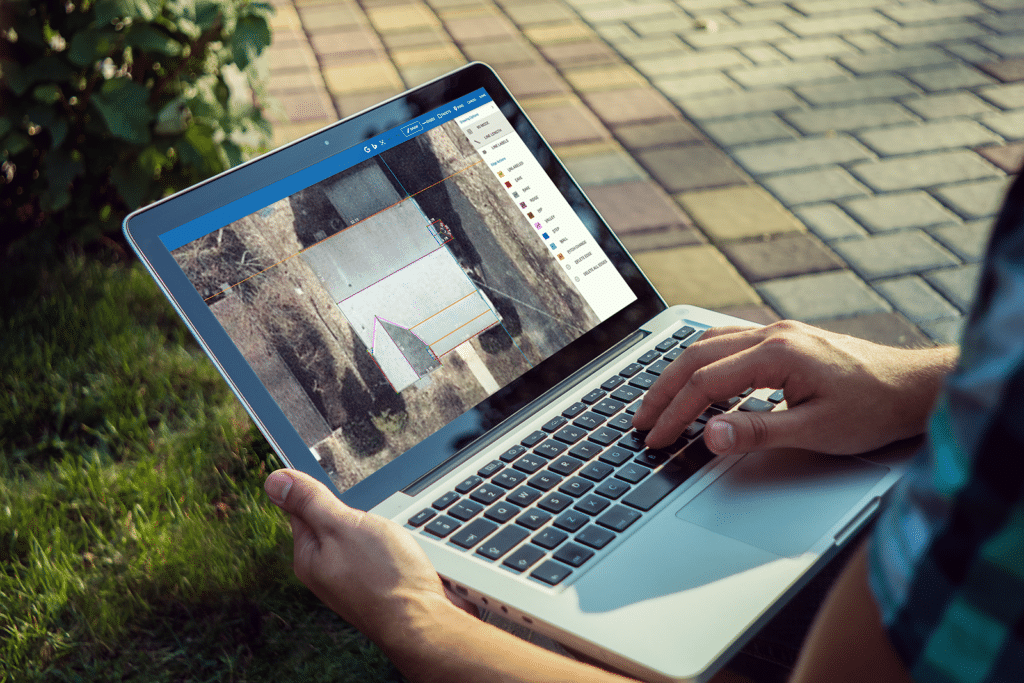
Accurate measurements are the foundation of a profitable roofing business. Mistakes will mean you either eat the cost of extra materials or overbid and lose jobs to your competitors.
Measurement and estimate software like EagleView can help you be more accurate. While EagleView is a popular option for roofers, it is not the best fit for every business in the industry. EagleView alternatives like RoofSnap and Hover offer different features and pricing. That said, it is not a good strategy to simply find software cheaper than EagleView. You need to understand what each product offers and then choose the one that matches your needs.
In this article, we will help you do just that. We’ll explore the top six EagleView alternatives and give you the details you need to choose the best roof measurement software. We will also share insights to help you find the right product for your business.
Why Roofing and Estimate Software Matters
Roofing businesses run on tight margins. The line between winning a profitable job and a losing one often comes down to two things: how accurately you measured and how fast you got an estimate to the homeowner.
Good software protects your bottom line in three ways.
- It removes the safety risk of climbing every roof.
- It cuts the errors that lead to wasted materials or underbidding.
- It shortens the gap between the first call and a signed contract.
Does speed really matter? Yes, it is more important than most contractors think. Deliver an accurate bid the same day, and you look professional and beat slower rivals.
There is no universal best aerial roof measurement software. A solo crew, a storm-restoration company, and a business relying on in-person sales all need different things.
The best roofing measurement software is the one that comes closest to meeting your needs while fitting within your budget.
Why Look for an EagleView Alternative?
EagleView has earned its reputation. For over a decade, it’s been the gold standard for aerial measurement. It captures complex roofs in detail, and insurance adjusters typically accept its reports.
That said, the software has limits. Prices can be high, with per-report billing often too expensive for smaller jobs. It struggles with newer homes that don’t yet appear in satellite imagery, and tree cover can hurt accuracy too.
Even regular EagleView users report falling back on other tools when imagery isn’t available.
Some EagleView alternatives are more feature-rich. For example, EagleView doesn’t build proposals, collect signatures, take payments, or manage your workflow. If you want the extras but still rely on EagleView, you may be paying for redundant services.
In the end, EagleView might be the best choice for some companies, but it can be beneficial to at least explore other EagleView alternatives for contractors in the roofing industry.
RELATED ARTICLE — Why Speed Has Become the Biggest Competitive Advantage in Roofing Estimates
How We Compared These Tools
We compared measurement software for roofers by focusing on the traits that affect your daily work and profit margins:
- Accuracy: Incorrect estimates cost you money. Accuracy is the foundation for every subsequent sales step.
- Speed: The faster you get a report, the faster you bid, and the more jobs you win.
- Pricing model: Per-report, flat-rate, and free tiers each suit different job volumes.
- All-in-one workflow: Some tools only measure. Others carry you all the way to a signed contract.
- Mobile use: If your team sells in the field, they need tools that work on a phone or tablet.
- Best-fit use case: Insurance, retail sales, and quick residential jobs each require different features.
Keep your own processes in mind as you read. Your goal should be to find the software that makes each step in your workflow easier.
Best EagleView Alternatives in 2026
Here is a deep dive into the six strongest EagleView alternatives.
1. RoofSnap
Best for residential roofers seeking value, speed, and an all-in-one estimating tool
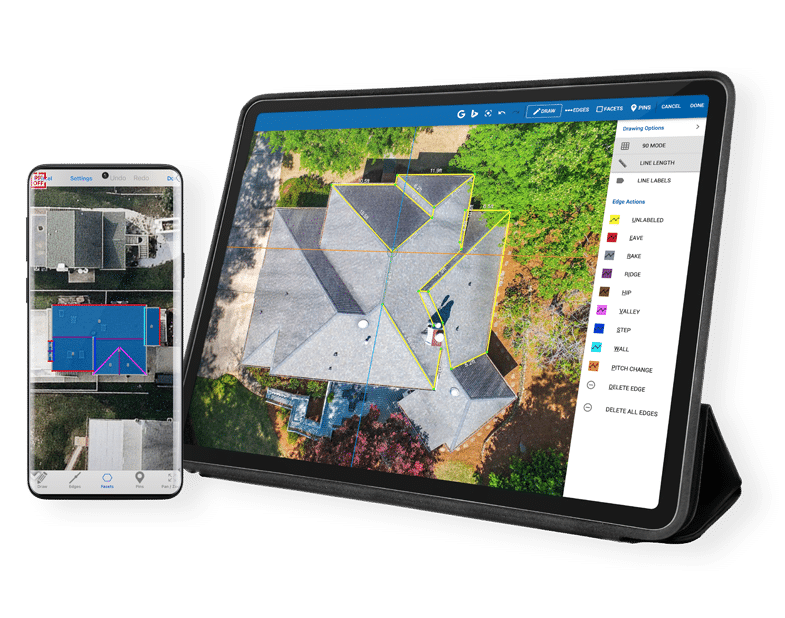
RoofSnap gives small residential crews the fastest path from measurement to a signed proposal. The software provides both DIY measurements you trace yourself and ordered reports, plus estimates, material orders, and contracts.
RoofSnap uses aerial imagery to automate measurements, quantities, and pricing, so you spend less time on-site and arrive at accurate bids quickly.
What stands out?
Value is the headline for many users. RoofSnap is often praised as one of the most cost-effective measurement-and-estimating tools. Pay-as-you-go pricing is attractive to smaller businesses, and the workflow is built around an estimate-bid-contract progression.
New additions like gutter measurements and built-in payment processing make RoofSnap an even more complete package.
What are the trade-offs?
RoofSnap has extras, but it isn’t a full CRM. You need to pair it with other tools if you need full project and sales management. And like any satellite tool, accuracy can dip in rural areas, so you still need to verify pitch on-site.
All that said, for a small crew that wants speed and affordability in one place, it’s hard to beat RoofSnap.
For further research, RoofSnap offers a detailed RoofSnap vs Eagleview comparison page.
How much is it?
RoofSnap offers pay-as-you-go measurement reports for $13 each and subscriptions starting at $52 per month per user.
2. Hover
Best for photo-based 3D models and homeowner sales presentations
Hover works differently than other EagleView competitors. Instead of satellite imagery, your rep takes photos, and Hover builds a 3D model of the whole house, not just the roof. After its 2026 relaunch, it now takes you from image capture to measurement to estimate to signed proposal in one flow.
What stands out?
For many users, 3D modeling is the main selling point. You can drop real products onto the homeowner’s actual house and let them see the result before they sign. Contractors often report higher close rates with this digital preview feature, especially when selling premium materials.
What are the trade-offs?
Hover requires a site visit since the software needs on-site photos to work. That gives up the “measure from the office” perk of satellite tools. Also, the per-project price is steep for low-volume users.
But if visuals drive help with your close rate, nothing else matches Hover.
How much is it?
The Starter package offers three free projects. Heavy users can pay $999 per year for the Pro tier, but they still need to pay for each report at a discounted rate.
3. Roofr
Best for measurement-to-proposal workflow with a free entry tier
Roofr streamlines the steps from measurement to a polished proposal. Unlike other EagleView alternatives, it has a genuinely free Starter plan. This tier includes a CRM lead pipeline, proposal templates with e-signatures, and pay-as-you-go reports. You can sign up without a credit card.
What stands out?
Users often point to Roofr’s proposal builder as its best feature. You can show good/better/best pricing options side by side, add branding, and collect e-signatures from the homeowner’s phone. Measurement data goes straight into the proposal with no manual work on your part. This is important because it saves time and eliminates the inevitable data re-entry errors.
What are the trade-offs?
Roofr has no native mobile app yet. For now, it runs through a mobile browser. This is a major drawback for field-based businesses. Satellite coverage gaps also affect the software. That said, starting Roofr on the free tier is a low-risk way to check coverage in your area.
How much is it?
Per-report pricing ($19) is available on the free Starter plan. Subscription plans start at $109 per month and offer additional features, cheaper reports ($13), and faster turnaround time.
RELATED ARTICLE — Is a Roofing Business Profitable? Margins & Earnings Explained
4. GAF QuickMeasure
Best value measurements for GAF-certified businesses
GAF QuickMeasure is a fast, focused measurement service from GAF, one of North America’s largest roofing materials manufacturers. It delivers reports in under an hour for single-family homes and under 24 hours for larger properties. Each report includes high-resolution imagery and an interactive 3D view.
What stands out?
GAF-certified contractors say that they get a lot of value from this tool. You get quick, fairly priced measurements and a clear estimate using GAF products. With a report, you can order materials automatically through AccuLynx without a separate GAF account.
What are the trade-offs?
QuickMeasure is a measurement service, not an all-in-one platform like many of the other alternatives to EagleView. You’ll have to buy another project management and CRM tool if you want additional features.
But if you’re already in the GAF world and want fast, reliable measurements, it’s a natural fit.
How much is it?
GAF-certified contractors get a slight discount, paying $18 for a single-family home report and $54 for a multi-unit building. Other pros pay $20–$60 per report.
5. iRoofing
Best for DIY unlimited measurements and app-based estimating
iRoofing has an alternative flat-rate roof measurement pricing model. Instead of buying each report, you pay a flat monthly fee for unlimited DIY measurements from satellite, aerial, drone, and blueprint images. For contractors making lots of bids, the subscription fee will offer more value than pay-as-you-go EagleView alternatives.
What stands out?
Reviewers are quick to point out that iRoofing offers more than measurements. It bundles pitch detection, an estimator, a roof visualizer, digital catalogs, a branded pitchbook, and e-sign contracts. The design is mobile-first, and setup is quick, with every subscriber getting free training and phone support.
What are the trade-offs?
iRoofing covers measurement, visuals, and proposals, not full CRM or accounting. It also has no Xactimate integration, which rules it out as a tool for insurance work. But if you are a residential roofing contractor who wants unlimited measurements and visual selling at a set price, iRoofer is a great value.
How much is it?
iRoofing costs $149 per month. If you pre-pay for two years, the per-month cost is effectively $107.
6. AccuLynx
Best for insurance and storm-restoration work needing CRM depth alongside measurement
AccuLynx is a purpose-built roofing CRM. It has tools for storm and insurance workflows: lead capture, sales pipeline, supplement management, adjuster communication, and material ordering.
What stands out?
AccuLynx doesn’t have a native aerial roof measurement tool. Instead, it integrates with EagleView and GAF QuickMeasure. You order reports inside the platform, and the data auto-fills your estimates. This means AccuLynx is a tool for businesses that need Xactimate and insurance claim management, with measurement folded in.
What are the drawbacks?
Because measurement is an add-on, you still pay EagleView pricing on top of your AccuLynx subscription. Unfortunately, the per-user price adds up fast for big sales teams. But for a roof-repair business that works with insurance companies and needs a repair-focused CRM, it’s the most complete option here.
How much is it?
AccuLynx requires a demo for current price quotes. However, reviewers point to a complex pricing structure as one of the software’s main drawbacks.
RELATED ARTICLE — Why Roofing Contractors Win More Jobs with Built-in Homeowner Financing
EagleView Alternatives Comparison Table
Here’s how the six EagleView alternatives stack up side by side:
| Tool | Best for | Measurements | Drawbacks |
| RoofSnap | Residential value, speed, all-in-one | Satellite + DIY, built-in estimating | No full CRM; verify pitch in rural areas |
| Hover | 3D visual sales | Photo-based 3D model of whole house | Needs a site visit; steep for low volume |
| Roofr | Measurement-to-proposal + free tier | Satellite + DIY fallback | No native app yet; satellite gaps |
| GAF QuickMeasure | GAF-certified shops | Ordered aerial reports, sub-hour delivery | Measurement only; pair with other tools |
| iRoofing | Unlimited DIY measurements | Flat-rate DIY from multiple sources | No Xactimate; not a full CRM |
| AccuLynx | Insurance/storm + CRM | None native; integrates EagleView & GAF | Measurement costs extra; high per-user price |
Replace EagleView or Supplement It?
Not everyone needs an EagleView alternative. Sometimes, combining it with other tools is the best option.
- Keep EagleView if most of your work is insurance restoration or complex commercial roofs and if adjuster-accepted accuracy is a must. Nothing can match EagleView’s insurance adjuster acceptance rate yet.
- Supplement EagleView if it works for most jobs but falls short in a few spots. Add Hover for new-construction homes it can’t see. Add Roofr, RoofSnap, or AccuLynx for proposals and a pipeline around it.
- Replace EagleView if you’re mostly residential and tired of per-report pricing. RoofSnap or iRoofing can cover measurement and estimating for far less, and Roofr’s free tier lets you test at no risk.
For many contractors, the honest answer is a mix: a primary tool for most jobs and a backup for the exceptions. Look at your job mix over the last few months and let that guide the call.
RELATED ARTICLE — Roofing Technology Trends: AI, Drones, and Automation
Why Contractors Choose RoofSnap
If you’re a residential contractor who wants speed, value, and estimating in one place, RoofSnap brings the benefits you need. It streamlines the steps from measurement to a signed contract, without the high EagleView pricing. The benefits are especially evident on smaller jobs when you can’t justify paying a premium for an aerial roof measurement report.
The all-in-one workflow is a major draw. You measure, build an estimate, order materials, and get the contract signed without having to toggle between apps and re-enter data.
No tool is perfect for every business, and the smart move is always to match the roof measurement software to your workflow. But if fast, affordable, all-in-one estimating sounds right, RoofSnap is worth a serious look. Get a free trial and run your own accuracy check on a few real jobs before you buy.
EagleView Alternatives FAQs
What are the different pricing options for roofing software?
Roofing software uses three main models: per-report (you pay for each measurement), flat-rate (unlimited measurements for a monthly fee), and free or pay-as-you-go tiers. The best fit depends on your volume. High-volume shops usually save with flat-rate, while occasional bidders do better with pay-as-you-go.
Do I need to measure manually if I have an aerial measurement?
Usually, the answer is no. A good aerial report gives you the dimensions, pitch, and material quantities you need to bid. It’s still smart to verify on-site in rural areas or on homes with heavy tree cover, where satellite imagery is less reliable.
How fast can I get a measurement report for a property?
It depends on the tool. DIY tools give instant results since you trace the roof yourself. Ordered reports usually arrive within an hour to 24 hours. GAF QuickMeasure, for example, guarantees single-family reports in under an hour during business hours.