What’s going on with AI applications in the roofing industry? Artificial intelligence (AI) is a bit of a buzzword at the moment, but more and more businesses in the industry are using it.
What for? Drones are measuring roofs from the air. Photos are being scanned for damage. Estimates are drafted in minutes instead of hours. And phones are being answered during storms without human intervention.
Roofing has always been a fast-moving trade. A storm rolls in, and phones start ringing. Whoever calls the homeowner back first usually wins the job.
That pressure is a big reason AI applications in the roofing industry have gained so much traction. They improve accuracy and save time. Sometimes, they can even boost the customer experience.
In this guide, we’ll explore nine ways you can use AI in your roofing company. Let’s get started.
AI Adoption in Roofing: Where Things Stand in 2026
Roofing has never been a slow-moving industry, but the stakes right now are a bit unusual.
IBISWorld projects the industry will reach $92.5 billion in revenue in 2026. That’s after growing at 5.0% a year for the past five years.
Extreme weather, an aging housing stock, and government infrastructure spending have all pushed demand higher. Roughly 80% of work now comes from re-roofing and renovations.
All this means teams are booked and busy. They’re working mostly on repairs for properties that already exist.
AI in roofing is a game-changer in this context. When demand outpaces the number of hands available, businesses that act faster without hiring more people gain a competitive advantage.
Many contractors sense how impactful this new era will be:
- 85% expect AI to cut down time spent on repetitive tasks.
- 75% believe it will help them learn from past projects using historical data.
That optimism hasn’t fully turned into adoption yet, though:
- Only 12% of contractors use AI in their day-to-day operations.
- Another 34% are experimenting with it.
In short, most of the industry sees the value, but most haven’t moved past testing.
Outside of roofing, 64% of companies say AI is enabling innovation. And 80% have set efficiency as a goal for their AI work.
RELATED ARTICLE — How to Estimate Labor Cost for Roofing: A Contractor’s Field Guide
The 9 Real-World AI Applications
AI applications in the roofing industry cover a whole range of different technologies. Each solves a different problem on the job.
Let’s unpack nine areas where artificial intelligence in the roofing industry is changing the way businesses operate.
1. Roof inspection & damage detection
Ever spotted a drone flying over the roof on a jobsite? Maybe you operate one yourself.
The goal is to spot missing shingles, hail hits, cracked tiles, and lifted flashing using AI-powered computer vision.
It’s a big safety win. Every minute you spend walking a roof deck is a minute of risk. Cutting that time down is always worthwhile, even before you factor in speed.
It’s no wonder so many roofers have adopted this tech already:
- 55% of projects now use drone technology for AI roof inspections.
- Some platforms report time reductions of 30–40%.
Of course, you’ll still need to make the final call. The drone and AI’s pattern-spotting abilities just get you there faster and safer.
2. Aerial measurement & 3D modeling
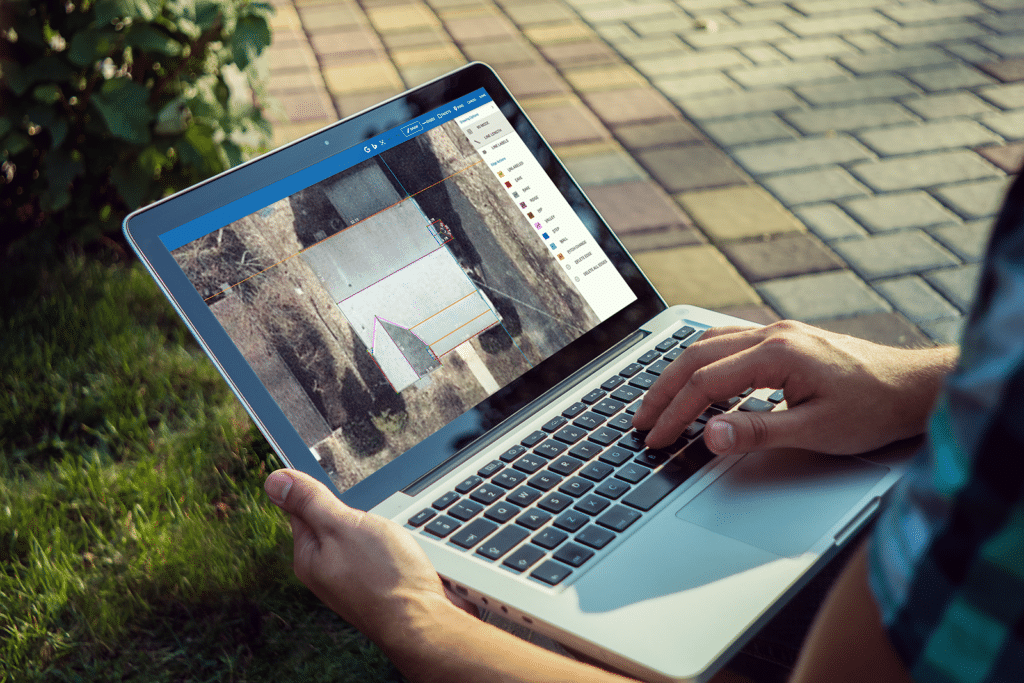
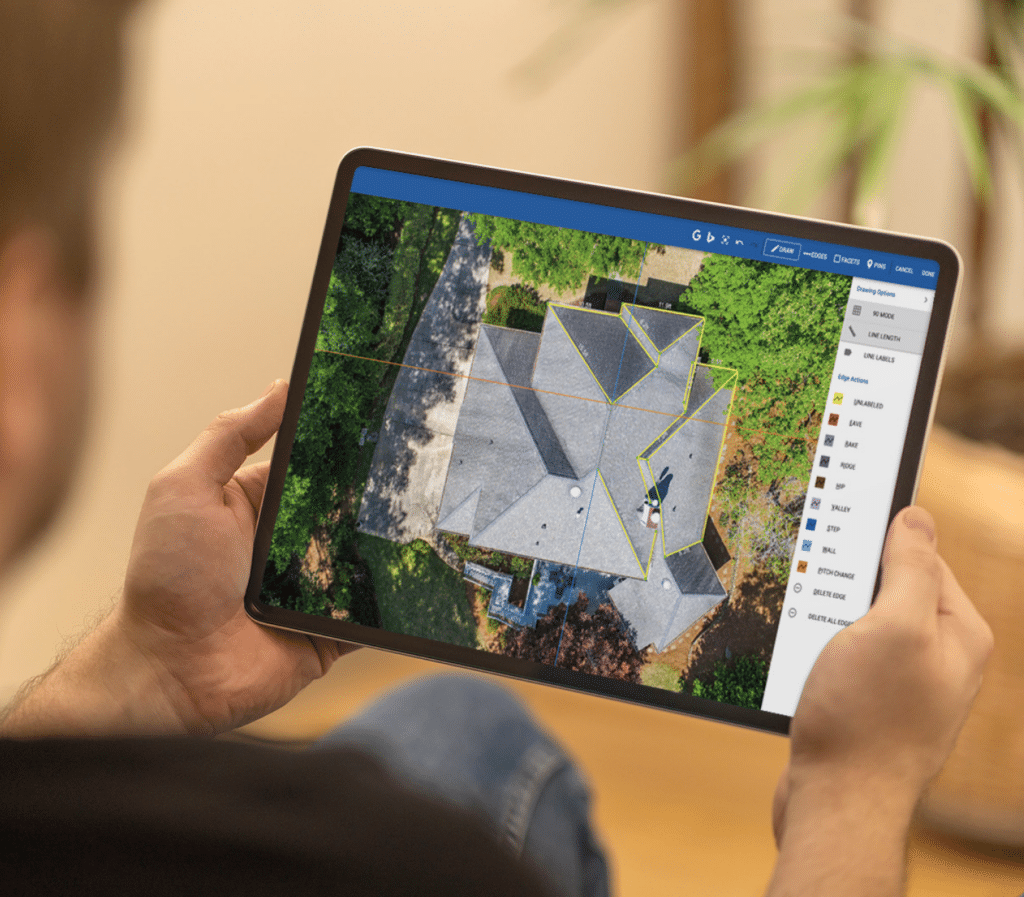
You used to need a ladder and an hour-plus to get a roof’s dimensions right. Now, satellite images, aerial photos, and drone data generate an accurate 3D model. No one has to step foot on the roof.
Tools like RoofSnap, Hover, EagleView, and Roofr all use this kind of AI roofing technology. Each one calculates measurements from photos or aerial imagery instead of a tape measure.
It’s extremely accurate too. According to EagleView, the platform is 98.77% accurate for measurements.
For you, that means:
- Faster quotes
- Fewer callbacks to re-measure a property you already visited
- Happier clients
3. AI-powered estimating
When you have a measurement, the next bottleneck is turning it into a price for your customer. This is where AI-powered estimating comes in.
Instead of calculating material and labor costs line by line, these tools generate AI roofing estimates straight from your measurements or photos. What used to take hours at a desk now takes minutes.
Take RoofSnap’s roof measurement tool and estimating features as an example. You capture the roof, then the software creates a working estimate from that data automatically.
It doesn’t replace your judgment on pricing, margins, or a customer’s specific situation. But it gets you to a starting number a whole lot faster than doing the math yourself.
You can send a quote right away, not three days later. And that might be the difference between winning or missing out on the job.
RELATED ARTICLE — How to Eliminate Human Error with Automated Roofing Estimating Software
4. Insurance claim & Xactimate documentation
Insurance paperwork is time-consuming. No doubt about that.
It’s not particularly fun either. The good news: AI is starting to do some of the heavy lifting.
Xactimate (the estimating software many adjusters and contractors use) now includes AI-assisted photo descriptions. The system generates labels for your project photos automatically. You don’t have to type out a description for every single image.
Here’s the important part, though. You still have to review and approve every AI-generated description. This isn’t a 100% hands-off tool.
If you decide to use it, be sure to:
- Double-check all AI-written descriptions against your own photos before submitting anything to an insurer.
- Don’t assume it caught every detail an adjuster might ask about.
- Treat it as a first draft that saves you typing.
- Jot down your own notes on anything unusual, since AI descriptions tend to be generic.
5. Storm response & AI receptionists / virtual call teams
After a big storm, your phone rings nonstop for days.
The thing is, many roofing companies just don’t have enough people to answer every call fast enough. That’s the gap AI receptionists are stepping in to fill.
An AI-based virtual call team can answer inbound calls. They can collect basic details from the homeowner and get an appointment booked, all without a person picking up the phone.
A good virtual call team can handle:
- Basic contact details and property address
- A quick description of the damage
- Whether the homeowner has already filed an insurance claim
- Scheduling a time for someone to come take a look
During storm season, the fastest quote usually wins. This tool gives you an edge when your call volume is at its highest.
You respond right away using AI. Then, you follow up manually. You win more work and have more opportunities to turn storm-season clients into loyal brand advocates.
6. Scheduling & operations
You’ve got three crews, five trucks, and 10 jobsites on the board today. Trying to track that by memory or a whiteboard? A team member is likely to arrive at the wrong address or get double-booked.
This is where machine learning in roofing does some of its best work.
Here’s how AI improves scheduling and operations:
- It routes crews based on location, so nobody drives all over town when a closer team member could’ve taken the job.
- It flags scheduling conflicts before they turn into a missed appointment.
- It adjusts the rest of the day’s plan automatically when a job runs longer than expected or weather causes delays.
Benefits include:
- Fewer double-bookings
- Less wasted drive time between jobs
- Fewer angry calls from a customer
7. Lead generation & marketing
Getting your name in front of the right homeowner at the right moment is half the battle.
AI might be able to help. Here’s how:
- Ad targeting: AI can help your ads reach homeowners more likely to need a roof soon, based on patterns like storm damage in their area or the age of their roof.
- Automated follow-ups: Instead of a lead going cold because nobody had time to call back, AI can send a text or email to keep the conversation going.
- Review automation: AI tools can send review requests automatically after a job wraps up. You don’t have to rely on remembering to ask every time.
- Before/after visualizations: Some tools use AI to generate a preview of what a new roof will look like on a specific house. This helps a homeowner picture the result before they commit.
None of this replaces a genuine relationship with your customer. It just makes sure fewer good leads fall through the cracks while you’re busy.
8. Predictive maintenance
Many roof problems get caught only after something already fails. Predictive maintenance flips that around, using AI to catch trouble before it turns into a failure.
Machine learning models analyze weather history, material degradation data, and sensor readings. They then forecast likely problems.
Think of it like a check engine light for a roof. Instead of waiting for a leak to show up on a ceiling, the system flags a section of roof showing signs of wear. It does this based on signals like:
- Age
- Sun
- Storm exposure
- How the specific material tends to break down
This technology is still emerging. It’s used more in the commercial space right now.
It’s often paired with Internet of Things (IoT) sensors. These are embedded in the roofing membrane and feed real-time data back into the model.
Building owners have the most to gain. A failure can lead to significant water damage to the equipment or inventory sitting underneath.
9. Smart roofing / IoT & thermal
This is the earliest-stage application on this list, but it’s still worth knowing about.
Smart roofing uses small, connected sensors built into or placed on a roof. These flag issues most people would never notice from the ground.
A few examples include:
- Leak sensors that detect moisture the moment it enters
- Infrared and thermal imaging that finds trapped moisture under roofing material
- Energy analytics that track how much heat a roof is letting in or out (helps a building owner understand their energy costs)
As smart roofing tech evolves, it could completely change maintenance relationships with your clients. Instead of a once-a-year inspection, you might monitor the roof continuously using AI and software.
RELATED ARTICLE — Roofing Technology Trends: AI, Drones, and Automation
Benefits AI Brings to Roofing Businesses
There are a ton of benefits that come from using AI in your roofing business. Here are just a few:
- You get from measurement to proposal a lot faster. Joshua Coffey, regional VP at Home Genius Exteriors, told Yahoo Local: “What used to take hours of manual measurements and guesswork can now be modeled in minutes with AI-driven 3D imaging and predictive tools.”
- Your figures get more accurate, but you still have to check them. AI can genuinely tighten up your measurements. Just don’t hand it full trust yet, especially around damage in shadows or other spots a camera can miss.
- You spend less time on the roof itself. Almost nobody argues with this one. Drone-based inspection means fewer ladder climbs and less time walking a deck.
- You respond to leads faster, even during storms. A lot of contractors still answer calls and book estimates manually, so speed alone can set you apart.
- You gain measurable wins in business performance and efficiency. About 38% of contractors now report measurable business impact from AI. This is up from 17% in 2025, with the biggest win around cost estimation and budgeting.
- Your skilled people spend less time on busywork. AI can manage takeoffs, scheduling, and photo documentation. This frees up your estimators and team members for the calls that need expert judgment.
Limitations, Risks, and What AI Can’t Do
AI is helpful, but it’s not without its risks and limitations.
- First, accuracy. Computer vision can miss damage hidden in shadows or misread a material it hasn’t seen much of. That’s exactly why Xactimate’s AI-assisted photo descriptions still require you to review and approve every single one.
- Next, client care. A homeowner dealing with storm damage wants to feel heard, not processed by a script. An AI receptionist can book an appointment fast. But it can’t read the worry in someone’s voice or adjust on the fly the way you would on a call with a stressed-out customer.
- Finally, professional judgment. AI can hand you a measurement, a damage report, or a draft estimate. It can’t decide whether a customer’s situation calls for flexibility on pricing or whether a borderline repair should really be a full replacement.
Here’s a quick reference guide for when and where to use AI in your roofing business.
| Task | Good fit for AI | Human input needed |
| Measuring a roof from aerial imagery | Yes | Spot-check for unusual rooflines |
| Detecting hail damage in daylight | Yes | Damage hidden in shadows or edge cases |
| Drafting a claim description | Yes | Final review before submitting to an insurer |
| Talking a homeowner through a stressful storm claim | Limited | Yes, almost always |
| Deciding on pricing flexibility for a specific customer | No | Yes |
| Scheduling and routing crews | Yes | Adjusting for last-minute changes or conflicts |
Getting Started with AI in Roofing
Keen to get started with AI? Take it one step at a time:
- Step 1: Pick one problem to solve. Look at where your time actually goes. Is it slow measurements? Missed calls during storm season? Hours spent on estimates? Start with your biggest single time drain.
- Step 2: Try a tool made specifically for that one problem. If measuring is your bottleneck, look at aerial measurement tools. If it’s phone overflow during storms, look at AI call handling.
- Step 3: Use it alongside your current process for a bit. Don’t rip out your existing workflow on day one. Try out the new tool next to what you already do, and compare the results before you commit.
- Step 4: Keep a human checking the output. Whatever tool you pick, treat its output as a draft. Review measurements, damage reports, and estimates before they go to a customer or an insurer.
- Step 5: Ask your team what’s working and what’s not. Your estimators and crews will learn pretty quickly whether a tool is a time-saver or time-waster. Take their feedback on board.
AI in Roofing FAQs
Here are answers to questions you might have about AI in roofing.
How is AI changing roofing?
AI is speeding up measurements, inspections, and estimates, while improving safety. It’s also helping contractors respond to leads faster.
What is the best AI roofing technology?
There’s no single best tool, since different problems call for different technology. Aerial measurement tools like RoofSnap and EagleView solve one problem. AI receptionists and scheduling tools solve entirely different ones.
How can roofing contractors save time with AI?
Start with your biggest time drain. That might be manual measuring, slow estimating, or missed calls during storms. Pick a tool made for that one problem before adding anything else to your workflow.
What are the benefits of roofing automation?
Faster measurements, fewer roof climbs, quicker lead response, and less admin work for your team. The trade-off is that every output still needs a human to check it before it reaches a customer.
Use AI to Boost Efficiency in Your Business
It’s incredible to ponder how AI will change how we work and run businesses. Just some of that potential is available to you right here, right now.
You don’t have to reinvent the wheel or learn some complicated system either. There are many user-friendly, AI-powered tools out there that genuinely save time.
Ready to get started with AI for roofers? Give these quick and easy tips a try:
- Have a think about the manual tasks that take up a lot of your time now. That could be measuring, estimating, or following up on missed calls.
- Research tools that can solve that problem. If they have a free trial or demo, sign up.
- If you already have tools on your radar, consider whether they’re all hype or a true problem solver. It might help to read reviews or real-world experiences.
- Get your team involved. Ask them what they spend their time on now. Question whether they’d be open to an AI-driven solution.