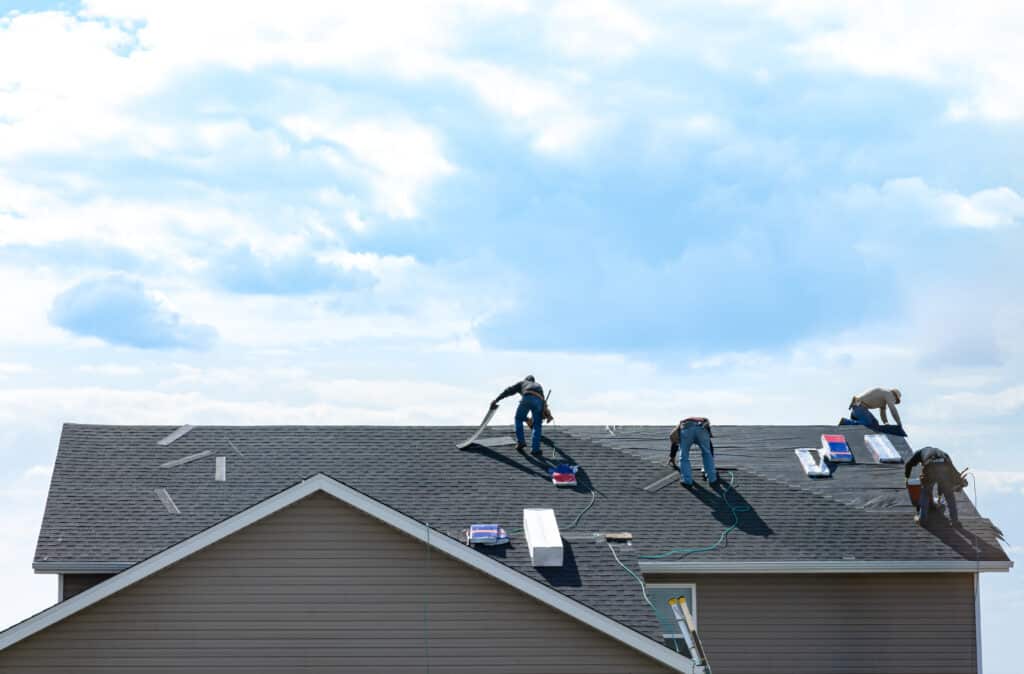
Every roof estimating software promises the same results: you’ll measure faster, close more sales, and get paid sooner. By the fifth sales demo, all the platforms start to blur together.
The real differences show up later. You need to know how the app handles a county that has no aerial coverage. Or what it does when the jobsite Wi-Fi drops. And whether “pricing available on request” means a real figure or a 40-minute sales pitch.
This guide breaks down the eight best roofing software platforms for contractors in 2026, with real pricing and honest trade-offs. Whether you need a simple roofing estimating app or full production tracking, we’ll help you match the right tool to your crew size and the kind of work you do.
Key Takeaways
These days, roof estimating software blends measurement, estimating, and CRM features into a single workflow. The right pick depends on your business type, your crew size, and whether you handle insurance claims. Pricing models vary widely, from per-user to per-report to flat annual fees. That difference affects your real cost more than any single feature.
What Is Roofing Estimating Software?
The best roofing estimate app helps you measure a roof, calculate material costs, and generate a quote for the customer. That’s the core job.
Roofing customer relationship management (CRM) is different. It tracks leads, schedules crews, and manages the sales pipeline after the estimate is done.
In 2026, most tools do both. RoofSnap, AccuLynx, and JobNimbus all bundle measurement and estimating with at least some CRM features. That overlap is worth knowing about, because it means you’re rarely buying just an estimating tool anymore. You’re buying a slice of your whole workflow.
According to Roofing Contractor’s 2026 State of the Roofing Industry Report, estimating software is now one of the most widely adopted technologies in the trade, with roughly two-thirds of contractors already using some form of it. If you’re not, you’re behind most of your competition.
RELATED ARTICLE — Why Speed Has Become the Biggest Competitive Advantage in Roofing Estimates
How to Choose Roofing Estimating Software
Before exploring the best roofing software, evaluate a few things about your business.
What kind of jobs do you actually run?
Retail residential, insurance or storm restoration, and commercial roofing all need different tools. A storm-chasing crew needs Xactimate compatibility to work with insurance claims. A commercial general contractor needs blueprint roofing takeoff software. A retail residential shop needs neither.
How many people are on your crew?
Pricing scales differently across tools. Per-user pricing increases costs as your company grows. Flat or per-report pricing is more predictable but can feel steep for a one-person shop.
Where do your measurements come from?
Some tools let you measure the roof yourself with your phone. For others, you order an aerial or satellite report. Commercial work usually means pulling measurements straight off a PDF blueprint, not walking the roof at all.
Do you need Xactimate or ESX compatibility?
Xactimate is the standard software insurance adjusters use to set repair pricing. If you handle storm damage or insurance claims, this isn’t optional. Your roofing proposal software or measurement app should import and export files in ESX format. Skip it, and you’ll create extra manual work for every claim, which is the kind of task software was supposed to save you from.
How do you want to pay?
Subscription, pay-per-report, and annual license models affect your operational cash flow differently. None of them is wrong. Do the math and pick the roofing bid software pricing that fits your business best.
Top Roofing Estimating Software in 2026
To find the best roofing estimating software for contractors—especially if you need commercial roofing estimating software—look beyond standard feature lists. Every vendor on this list can measure a roof, but they all take different paths to get you to a signed contract.
To evaluate the eight best roofing software platforms, we cross-referenced verified user ratings across Capterra and G2, alongside real-world contractor feedback.
Pricing for roofing software changes frequently and varies by team size. The figures we provide are reliable benchmarks. Confirm final rates with vendors.
Below are eight top tools worth knowing in 2026.
1. RoofSnap
Best for
Residential value, mobile DIY measurement, and transparent payments
What it is
A mobile-first measurement and estimating app built for roofers who want to go from roof to price without leaving the field
Standout strengths
You can measure the roof yourself from your phone or order an aerial measurement, all in the same app. Snap Estimates then builds a Good-Better-Best pricing option automatically. Payments run through Stripe, built right in, at 2.9% + $0.30 per card transaction or 1% for ACH.
Trade-offs
There’s no free tier. Some reviewers flag image add-on fees as a surprise once the invoice arrives. And the CRM side stays light on purpose, so JobNimbus or AccuLynx will outmuscle it if deep pipeline management is what you need.
Pricing
Pay-as-you-go reports start at $13 per standard measurement, a solid way to test the tool before committing to a plan. Monthly subscriptions start at $105 per user. Annual billing drops to $78 per user for a 2- to 4-person crew, $61 for 5 to 9, and $52 for 10 or more.
Who it fits
Crews under 10 people whose real bottleneck is getting from “roof measured” to “customer paid,” without stitching together four separate tools to do it
2. Roofr
Best for
Per-report measurements and fast proposal workflows for residential contractors
What it is
A web-based estimating and sales platform built to move residential roofers from satellite measurement to signed contract fast
Standout strengths
The free Starter plan has no credit card required and includes real job tracking, DIY satellite measurements, and a drag-and-drop proposal builder with e-signatures. It’s usable, not just a trial, though it caps you at 10 proposals before you’ll want to upgrade.
Trade-offs
No native mobile app, so field crews work through a browser. Satellite coverage has gaps in rural areas. Not built for commercial takeoff or heavy insurance work. And every plan charges per report on top of the subscription. Run 30 reports in a busy month on a paid plan. That’s $390 in report fees alone, before the monthly fee.
Pricing
Roofr overhauled its pricing in March 2026 (ignore older $89 or $149 numbers still floating around):
- Starter: Free forever, $19 per report
- Essentials: $249 a month ($209 billed annually), $13 per report
- Scale: $349 a month ($299 billed annually), $13 per report
Who it fits
Residential contractors who want a real free tier to test on and are prepared to pay per report as volume climbs
3. AccuLynx
Best for
All-in-one software for storm restoration and larger shops
What it is
A full production platform built around insurance restoration work, from first estimate through the last supplement
Standout strengths
AccuLynx has the deepest insurance workflow in this category. It handles supplement management, adjuster tracking, and material ordering from major suppliers, plus native EagleView integration for measurements.
Trade-offs
No native Xactimate integration, despite marketing that can make it sound like there is one. If your supplement process runs through Xactimate, you’ll still do that step separately. Pricing also climbs fast as you add users, so it gets expensive once you’re past a small team.
Pricing
Starts around $250 a month for the entry plan. Higher tiers, which add advanced automation, custom workflows, and multilocation management, are quote-gated, so get a number from AccuLynx before budgeting.
Who it fits
Storm restoration and insurance-heavy shops running five or more people who need deep supplier and production tools and don’t mind keeping Xactimate as a separate step
4. EagleView
Best for
Measurement accuracy for insurance, Xactimate work, and commercial jobs
What it is
An aerial measurement service that generates highly detailed roof reports, built to be trusted by insurance adjusters
Standout strengths
EagleView is the industry standard for measurement accuracy, and it holds up on complex commercial roof shapes that trip up other tools. Reports export into Xactimate through ESX files, and it has the broadest acceptance among insurance carriers of any tool on this list.
Trade-offs
It costs more than most competitors, and reports take longer to arrive, typically a day or two rather than same-day. It’s also not really a full estimating platform on its own. It’s a measurement report you plug into other software.
Pricing
Pay-per-report, with cost rising based on roof complexity. No flat monthly subscription for basic use, so budget per job rather than per month.
Who it fits
Contractors doing high-volume insurance work or complex commercial jobs, where accuracy and adjuster acceptance matter more than speed or cost
5. JobNimbus
Best for
Estimating that rides on top of a full CRM and production pipeline
What it is
An all-in-one CRM and job management platform for roofing contractors, with estimating built in rather than bolted on
Standout strengths
The lead-to-invoice pipeline is one of the strongest in this category, with customizable Kanban boards for tracking jobs through production. The mobile app is well reviewed, and it’s a solid fit for shops that want sales, production, and estimating all living in one system.
Trade-offs
Pricing is layered, which makes the real monthly total harder to predict than a flat-rate competitor. It’s also more CRM than dedicated estimating tool, so if measurement accuracy is your main concern, this isn’t built around that the way EagleView or RoofSnap is.
Pricing
JobNimbus uses custom quote-based pricing structured around a base platform fee plus per-user licenses. Expect a base plan between $225 and $550 a month, plus $25 to $75 per user, plus a separate fee if you want text messaging. A solo operator with one seat lands around $300 to $350 a month before add-ons. Onboarding runs another $500 to $2,000 depending on company size.
Who it fits
Mid-size residential shops that want their CRM and their estimating tool combined, instead of stitching two separate products together
6. iRoofing
Best for
Unlimited DIY measurements, visual sales presentations, and flat-rate pricing for small to mid-sized teams
What it is
A mobile-first presentation, measurement, and estimating platform built for field reps to measure roofs from satellite, aerial, drone, or blueprint imagery, show property owners realistic material renderings over a photo of their actual home, and generate contracts on tablet or phone
Standout strengths
The visualizer is the standout feature, letting a homeowner see shingle or material options rendered onto a photo of their actual roof rather than a stock image. It’s considered one of the best tools in this category for closing deals in person. It includes its own proprietary aerial imagery through Clearoof. Measurements are unlimited on every plan.
Trade-offs
No native Xactimate integration or ESX export, so it’s not built for insurance or storm restoration work. The CRM side is light, more of a sales tool than a full business platform. And the visualizer works over a 2D photo of the house, not a full 3D model, so it’s less impressive than Hover for a full exterior remodel.
Pricing
$149 monthly if you pay month to month. Drops to $124 a month with a 12-month commitment or $107 a month with a 24-month commitment. Flat rate covers up to 3 users, with unlimited standard-resolution measurements included.
Who it fits
Small residential retail roofers who close deals in person and want a strong visual tool to help make the sale on the spot
7. Hover
Best for
Photo-based 3D models for homeowner presentations
What it is
An app that builds a full 3D exterior model of a house from smartphone photos alone, no drone or ladder required, which contractors then use to show homeowners exactly what different materials will look like on their actual home
Standout strengths
The 3D modeling from phone photos is the best in this category for homeowner-facing visualization. Contractors report higher close rates after using it to show material and color options on the model, especially for exterior work that includes siding alongside roofing.
Trade-offs
Someone still has to visit the property to take photos, so it’s not a remote or pre-storm canvassing tool. Pricing is opaque and charges per scan, which adds up fast for a low-volume shop. For roof-only work without a siding or exterior angle, the visualization matters less, and cheaper measurement-first tools are a better value.
Pricing
Pay-as-you-go, with a per-scan cost that isn’t fully public. Recent pricing points to a $99-a-month Pro tier plus per-scan fees. Older sources list a $999-a-year flat Pro plan instead, likely outdated after Hover’s January 2026 relaunch. Confirm current pricing with Hover.
Who it fits
Mid- to high-volume contractors who want measuring, design, and proposal work in one tool, especially those doing exterior or siding work alongside roofing
8. STACK
Best for
Commercial roofing takeoff, plan-based blueprint measuring, and multi-trade contractors bidding off construction drawings
What it is
A cloud-based takeoff and estimating platform that lets you measure and price a job directly off a digital PDF blueprint, no climbing a roof or ordering satellite reports required
Standout strengths
On-screen takeoff from digital plans is fast and accurate, with a deep library of pre-built material and labor assemblies for repetitive commercial work. It is built for volume, making it ideal for an estimating team running dozens of commercial bids a month.
Trade-offs
It has a steep learning curve and is overkill for retail residential roofing. Because it is 100% cloud-based, a poor jobsite Wi-Fi connection creates noticeable performance lag. It is also more expensive than residential satellite measuring apps.
Pricing
STACK splits its software into two products, which is why you’ll see different prices floating around. Build & Operate, a lighter project-management tool, runs about $599 a year. Takeoff & Estimate, the version roofing contractors actually need for blueprint measuring, runs $2,599 to $2,999 a year per estimator seat, or roughly $217 to $250 a month. A limited free trial is available.
Who it fits
Commercial general contractors and specialty roofing estimators doing high-volume blueprint takeoff from architectural drawings
RELATED ARTICLE — The Best Apps for Roofing Contractors Managing the Whole Job Cycle
Roofing Estimating Software Comparison Matrix
| Tool | Best For | Pricing | Insurance Ready | Free Tier |
| RoofSnap | Residential & payments | Subscription | No | No |
| Roofr | Free entry & proposals | Free + $249–349/mo | No | Yes |
| AccuLynx | Storm restoration & larger shops | From $250/mo per user | Partial (no native Xactimate) | No |
| EagleView | Insurance/Xactimate & commercial | Per-report ($15–87+) | Yes | No |
| JobNimbus | CRM + estimating combined | Quote-gated, base + per-user | Partial | No |
| iRoofing | Visual sales | $107–149/mo flat | No | No |
| Hover | 3D homeowner presentations | Pay-per-scan or subscription | Partial (exports ESX) | No |
| STACK | Commercial takeoff | Annual, per-user | No | Limited trial |
How Much Does Roofing Estimating Software Cost?
The real pattern is simple once you see it: per-user tools scale up as your crew grows. RoofSnap, AccuLynx, JobNimbus, and STACK all fall into this bucket.
Flat or report-based tools, like Roofr or iRoofing, are more predictable month to month, even if the sticker price looks bigger up front.
Several vendors, including AccuLynx and JobNimbus, are quote-gated, meaning you won’t find an exact final figure without talking to a sales rep.
Treat any total cost estimate in this article as a starting benchmark, not a locked-in number. Confirm direct rates before you budget.
Which Roofing Estimating Software Is Right for Your Business?
Start with what kind of work you do most:
- Retail residential: Roofr, RoofSnap, or iRoofing, depending on whether you want a free entry point, transparent payments, or an in-home visual sales tool
- Storm and insurance restoration: EagleView or AccuLynx (AccuLynx still has no native Xactimate integration, so plan for that as a manual step)
- Commercial roofing: STACK, for PDF-based blueprint takeoff at volume
- All-in-one job and production management: JobNimbus or AccuLynx, if you want sales pipelines and supplier ordering in the same platform where you build estimates
Where RoofSnap Fits
RoofSnap is one of the strongest options for solo operators and small residential crews who want measurement, estimating, and payments in one mobile-first tool without paying for a CRM they won’t use.
It shines when your bottleneck is speed: measuring fast, quoting fast, getting paid fast. It’s not the best fit for commercial blueprint takeoff or heavy insurance supplement work. STACK or AccuLynx handle those better.
Roofing Estimating Software FAQs
What’s the difference between a roofing CRM and estimating software?
Estimating software measures the roof and builds the price. A CRM manages leads, scheduling, and the sales pipeline around that estimate. Most 2026 tools blend both to some degree.
Does roofing software work with Xactimate?
Some do, and some don’t. EagleView exports into Xactimate through ESX files. AccuLynx currently does not have native Xactimate integration, despite offering other insurance-workflow features. Always confirm compatibility before you commit.
Is there free roofing estimating software?
Roofr offers a free Starter plan. Most other tools on this list are either subscription or quote-gated, with no significant free tier.
Start Today
Before you sign up for anything, move forward at no cost:
- Write down your last 10 estimates. Note how long each one took and whether the job closed. That’s the baseline you’ll compare any new tool against.
- Check if you need Xactimate compatibility. Count how many of your jobs last year were insurance claims. If it’s a small slice, you may not need to pay for that feature.
- Ask your crew what slows them down most. Slow measurement? Confusing proposals? Chasing payments? Their answer tells you which tool to focus on.
RELATED ARTICLE — How to Eliminate Human Error with Automated Roofing Estimating Software